What looked like a piece of mud turned out to be a 30,000-year-old squirrel



 Follow Earth on Google
A miner in the Yukon’s Klondike gold fields picked up a lump of fur that turned out to be a 30,000-year-old ground squirrel.
That small body, curled as if asleep, captures a quiet moment from the last ice age in Tr’ondëk Hwëch’in territory. It links an ancient animal directly to the Yukon that people know today.

The work was led by Grant Zazula, a paleontologist with the Government of Yukon. His research focuses on the ice age history of small mammals and the environments they lived in.
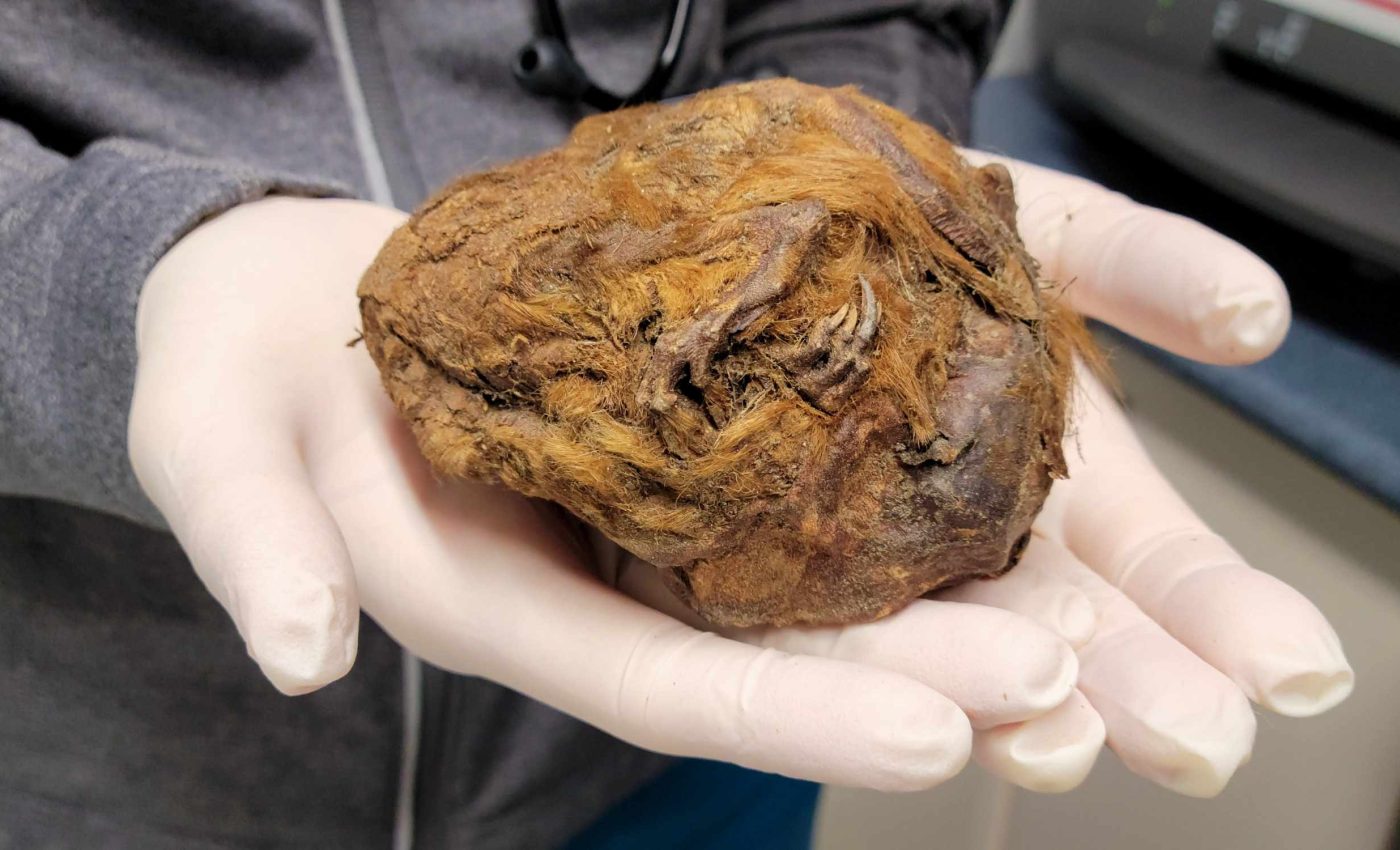
In 2018, a miner at Hester Creek in Yukon picked up a brown lump of fur the size of a large grapefruit. That unremarkable looking bundle turned out to be a curled-up Arctic ground squirrel (Spermophilus parryii) that had not seen daylight for tens of millennia.
“It’s not quite recognizable until you see these little hands and these claws,” said Zazula. At first, even experienced researchers struggled to say what the animal was from the outside.
“We could see that it was in great condition and it was just curled up like it was sleeping,” said Jess Heath, a veterinarian. To avoid damaging the specimen, Zazula brought it to veterinarian Jess Heath for an X-ray scan at a clinic in Whitehorse.
Life of a Yukon ground squirrel
The mummified animal belongs to the same species as Arctic ground squirrels that still move across the Yukon today. These rodents live in colonies on open hillsides and tundra, where they dig deep burrows and spend much of the year.
Arctic ground squirrels build nests for winter inside their burrows, stuffing them with dried grasses and seeds that trap clues about past plant life.
During hibernation, a deep seasonal sleep that slows body processes, their body temperature can fall slightly below the freezing point of water.
During the last Ice Age, the region called Beringia stretched across what is now Alaska, Yukon, and eastern Siberia. It was an ancient land bridge that connected Asia and North America, and supported a dry, grassy landscape.
Unlike mammoths and many other large animals, Arctic ground squirrels made it through those climate swings and still live in Yukon and Alaska.
Their long story of adaptation helps researchers ask how small, cold adapted mammals might respond to rapid warming in the coming decades.
Permafrost as an ancient archive
Hester, as the squirrel has been nicknamed, survived because it was sealed inside permafrost, soil that stays frozen for many years.
Cold, dry conditions in this frozen ground slow decay so much that fur, skin, and even tiny whiskers can remain recognizable.
Across the northern hemisphere, frozen soils store vast amounts of ancient plant matter and locked away carbon. When that ground thaws, microbes break down the material and release greenhouse gases like carbon dioxide and methane into the atmosphere.
As climate warming speeds up, ancient plants, animals, and long buried microbes once locked in frozen ground are expected to appear at the surface.
Some of those microbes are pathogens that can cause disease in people or animals, so researchers are watching these changes closely.
Scientists who work with permafrost mummies balance excitement about new specimens with strict safety rules and guidance from local Indigenous communities.
Each find, including Hester, becomes part of that shared effort to understand ancient ecosystems without putting present day people at risk.
Other ice age neighbors in Yukon
Hester is not the only animal that the Klondike permafrost has kept remarkably intact. Miners unearthed a gray wolf pup called Zhùr from thawing sediments near Dawson City. It was complete with fur and teeth, and its muscles were still visible.
Detailed analysis showed that Zhùr lived about 57,000 years ago and died when her den suddenly collapsed around her. Scientists used her bones, teeth, and DNA to trace her family ties to ancient Beringian wolves and to reconstruct her short life.
Careful work on Zhùr, from analyzing her tissues to sequencing her DNA, shows how researchers can read entire life stories from permafrost mummies.
In 2022, miners in the Eureka Creek area uncovered Nun cho ga, a woolly mammoth preserved with skin and hair. Analysis of this calf suggested it died around the same period as Hester, offering another close look at Yukon life in that ancient world.
Together, finds like Hester, Zhùr, and Nun cho ga reveal a full community of animals that shared the ancient Yukon landscape. They include not only famous giants but also the smaller creatures that carried seeds, dug burrows, and fed many predators.
Lessons from the Yukon squirrel
Hester the squirrel preserves not only bones but also skin, fur, and the curled posture it held in its burrow. That level of detail lets scientists compare its skeleton and teeth with living ground squirrels to spot subtle changes across thousands of years.
“I study bones all the time and they’re exciting, they’re really neat,” said Zazula. For him, a whole mummified animal does more than bones alone to connect people with the ancient north.
Specimens such as Hester, Zhùr, and Nun cho ga show how much information permafrost still holds about past climates, diets, and ecosystems.
At the same time, their appearance on mine walls and valley sides is a reminder that the frozen ground preserving them is changing fast.
Information from an online article by CBC News.
Image credits: @yukonberingia.
—–
Like what you read? Subscribe to our newsletter for engaging articles, exclusive content, and the latest updates.
Check us out on EarthSnap, a free app brought to you by Eric Ralls and Earth.com.
—–