New sponge species is so strange it was given the name 'magnificent alien'



 Follow Earth on Google
Far below the Pacific waves, nearly 6,560 feet down, a pale sponge on a thin stalk lives on a cold, dark slope. This new sponge was given the scientific name Advhena magnifica, which means “magnificant alien,” which is an apt description.
Scientists have now given this deep sea oddity a formal identity, a new glass sponge, an animal with a skeleton made of natural glass.

Its name comes from Latin words meaning “magnificent alien,” and the sponge was first collected during a NOAA expedition in the western Pacific.
Finding Advhena magnifica
A remotely operated vehicle cruised over a seamount, an underwater mountain rising from the seafloor, south of Hawaii and found a hillside covered in tall, stalked sponges.
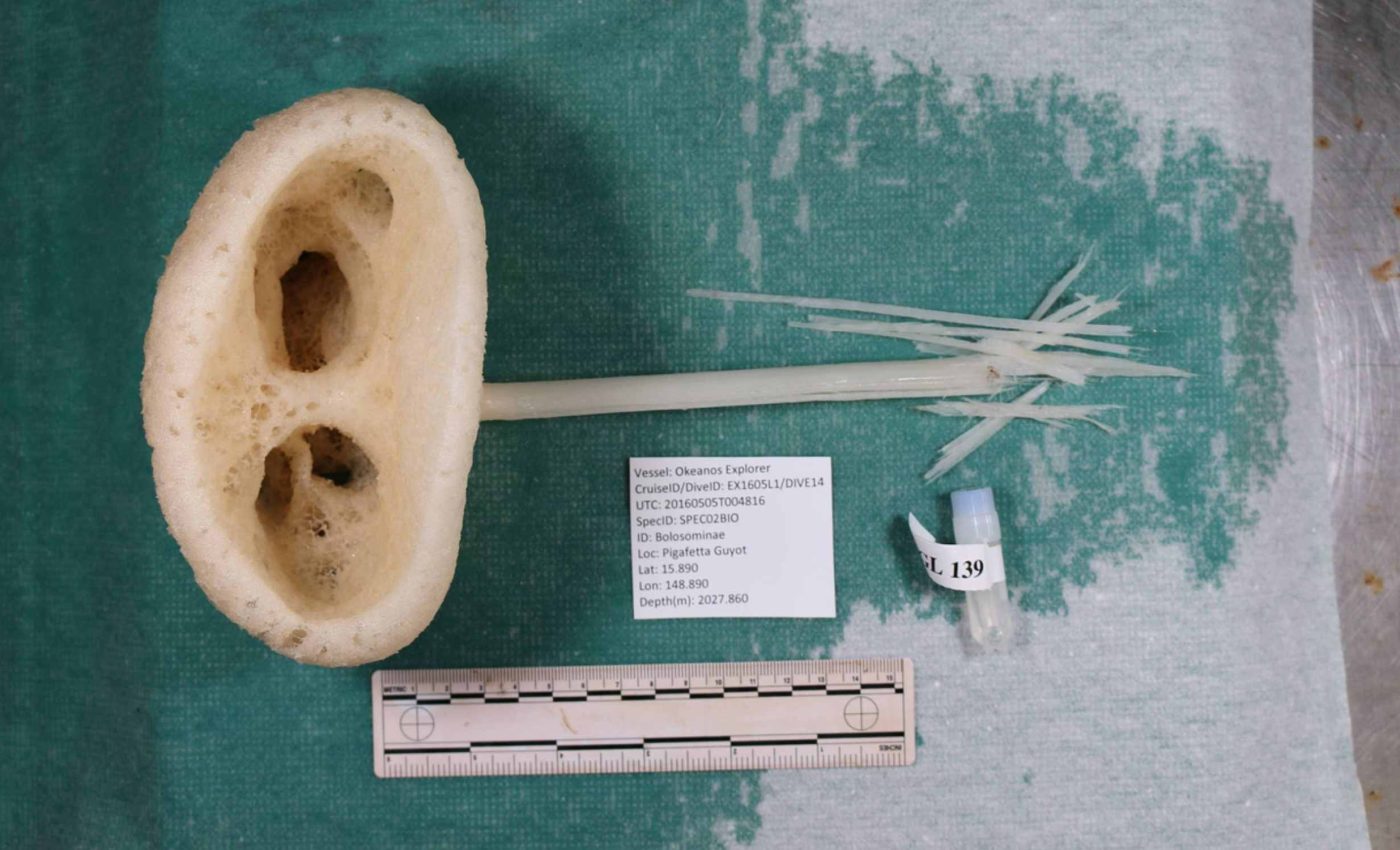
One of them towered over the bottom, holding a flattened, head like body with two large eye shaped holes turned into the current.
The work was led by Dr. Cristiana Castello Branco, a sponge taxonomist at the Smithsonian’s National Museum of Natural History (NMNH).
Her research focuses on deep sea hexactinellid, a class of sponges with glass skeletons, and on how their diversity evolved across the ocean.
A year earlier, Okeanos Explorer had already collected a single specimen from another Pacific undersea mountain east of the Mariana Trench.
That strange sponge, Advhena magnifica, was carefully archived at the museum in Washington, D.C., giving researchers a physical example to match with later video sightings.
In that community, the new sponge rose on a very long stalk with a rounded body perched on top.
Two big openings dominated its face like oversized eyes; these oscules, large outflow holes for water, let the sponge flush away filtered seawater.
Recognizing a new species
From the outside, many deep sea sponges can look similar, so scientists turn to microscopic anatomy.
In the lab, researchers break tiny pieces of the skeleton apart to examine spicules, minute glassy rods that form the sponge’s internal scaffolding.
In 2020, a taxonomic study formally described the sponge as a new genus and species named Advhena magnifica.
The analysis relied on its raised body shape and distinctive spicules to separate it from all previously known glass sponges.
Explorers also traced its home to an isolated guyot, a flat topped seamount called Pigafetta Guyot in the North Pacific.
Strong currents there sweep food particles past the sponge’s raised body and keep sediment from smothering its delicate structures.
“While we know very little about deep-sea sponges, we do know they are very abundant,” said Branco. She first examined the sponge material while completing her doctoral research.
Living life as Advhena magnifica
Glass sponges belong to the class Hexactinellida, a group of sponges with silica skeletons. Their interlocked skeletal rods form lattices that hold the body high above the seabed.
Unlike most animals, their bodies are made of syncytial tissue, a continuous living sheet with many nuclei sharing one membrane.
That structure lets glass sponges conduct electrical signals rapidly, so they can halt water flow when heavy sediment or other disturbances strike their surface.
A Canadian science advisory report notes that glass sponges can stop pumping within seconds when sediment lands on them.
The same work shows that some reef forming species remove nearly 99 percent of bacteria from the water they filter.
Their filtering does far more than just clean the water. Metabolic modeling shows that sponges and their microbes turn organic carbon into carbon dioxide and convert nitrogen into nutrients for other animals.
Lessons from Advhena magnifica
Finding a sponge that requires its own genus reminds scientists that even studied ocean basins still hide major branches on the tree of life.
Each species adds a datapoint to maps of biodiversity, the variety of living things, and sharpens estimates of how much life remains unknown.
Broader reviews show that dense deep sea sponge grounds act as long lived habitats, offering shelter and food to many invertebrates and fish.
Those same studies warn that bottom trawling and heavy fishing gear can crush sponges and strip away centuries old habitat in a single pass.
Work on glass sponge reefs in the northeast Pacific has also revealed their role in the silicon cycle.
Field research found that some reefs hold enough biogenic silica in sponge skeletons to rival the silicon pool of surrounding waters.
The glass sponge with the elongated head and two openings may look like a science fiction creature, yet it lives on the Pacific seafloor.
Its presence hints that there are more alien seeming forms waiting in the depths and that the catalog of life on Earth remains incomplete.
Image courtesy of NMNH.
—–
Like what you read? Subscribe to our newsletter for engaging articles, exclusive content, and the latest updates.
Check us out on EarthSnap, a free app brought to you by Eric Ralls and Earth.com.
—–