This geometric puzzle has intrigued mathematicians for 300 years



 Follow Earth on Google
Take two identical cubes and ask whether one can pass straight through a tunnel drilled in the other. Now extend that question to every well-behaved solid you can build from flat surfaces. What’s your answer?
In 2025, Jakob Steininger and Sergey Yurkevich introduced the Noperthedron, a carefully-engineered object with ninety vertices and a dense shell of polygonal faces.

They showed that no matter how you orient two copies of this shape, there is no tunnel that lets one slide through the other.
The Rupert property
The work was led by Jakob Steininger, a mathematician at Statistics Austria in Vienna. His research focuses on Rupert property, the ability to move a twin through a tunnel, and on algorithms that detect such passages in solids.
Prince Rupert of the Rhine once wagered that a cube could not contain a tunnel wide enough for an equal-sized cube.
John Wallis, one of the leading English mathematicians of the era, proved that the bet could in fact be won by Rupert.
Later, Pieter Nieuwland found the orientation that gives the largest possible cube through such a hole, about six percent larger than the original.
That history underlies a modern paper that surveys Rupert problems and builds algorithms to tackle them.
Over time, mathematicians discovered that many well known solids have Rupert passages, including all five Platonic solids.
One landmark solids study proved every Platonic solid Rupert, building on earlier insights into the cube and keeping the conjecture alive.
Rupert property tunnels
To say a solid has Rupert property is to say you can cut a tunnel through it so a copy travels inside the channel.
Mathematicians restrict attention to a convex polyhedron, a solid with flat faces and no inward dents, because those shapes are easier to describe precisely.
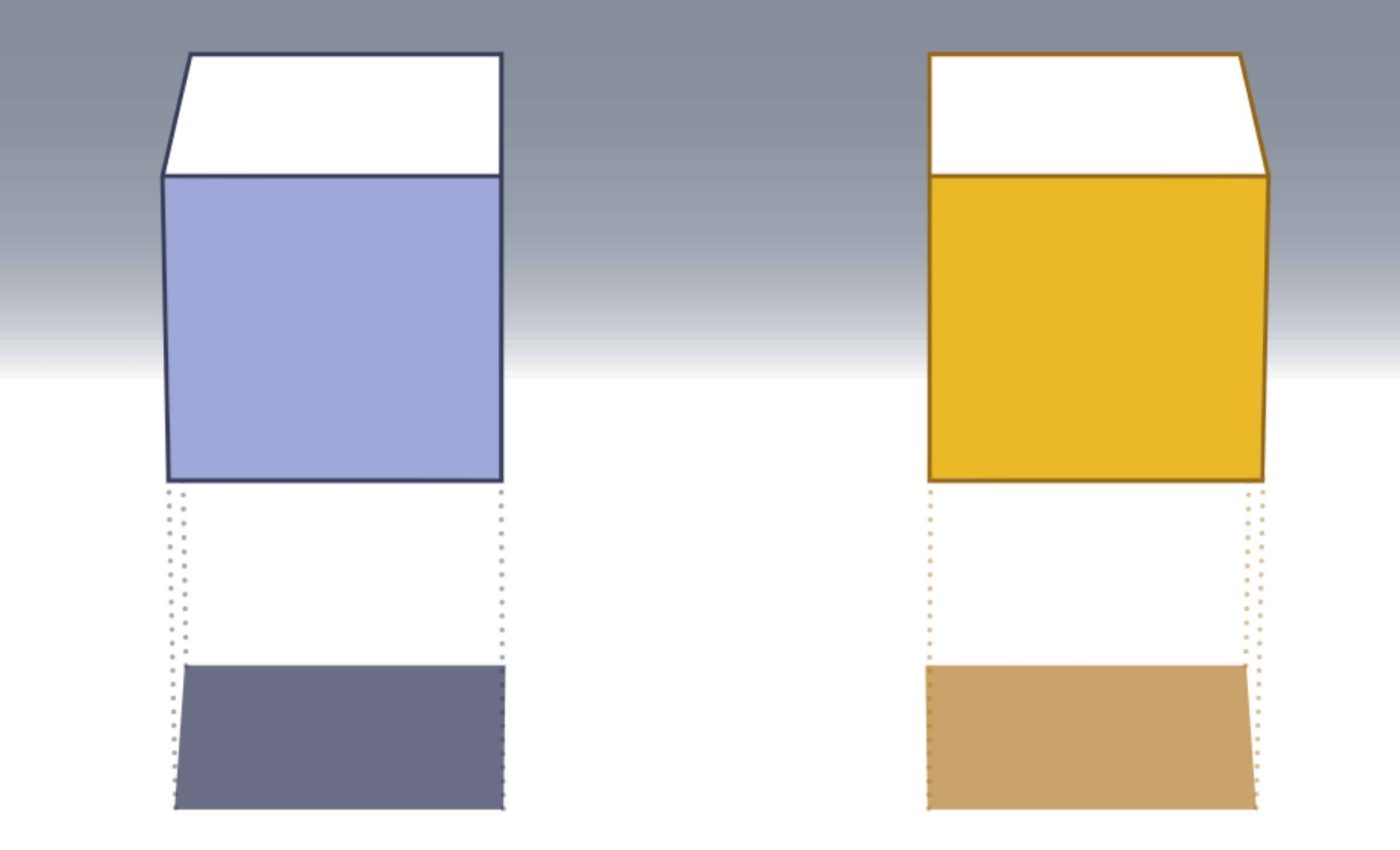
Instead of drilling physical holes, they study projection, the flat shadow a solid casts from some direction.
A Rupert tunnel exists when one orientation casts a shadow that sits completely inside the shadow from another orientation.
Every way to rotate two copies of a solid corresponds to a point in a five dimensional parameter space, a grid of choices.
Steininger and Yurkevich needed to prove that nowhere in that enormous grid does the Noperthedron admit a Rupert tunnel.
They first developed two sets of inequalities, called a global theorem and a local theorem.
The global result rules out large blocks of orientations at once, while the local result deals with tiny nudges of a promising pose.
Noperthedron blocks every tunnel
The Noperthedron itself is point symmetric and built from rational coordinates chosen with great care.
Point symmetry here means that every vertex has a partner exactly opposite the center, so the shape balances perfectly around the origin.
Two large fifteen sided faces cap the top and bottom, with one hundred fifty triangular faces forming a ring around the middle.
Those triangles line up so that any passage you try to carve eventually hits a wall that keeps a second copy from lining up.
To turn this into a theorem, the pair sliced the five dimensional parameter space into about eighteen million small boxes.
From each box, their software tested one representative orientation and used the global and local results to rule out all nearby orientations.
Why this shape changes everything
Before this work, many specialists suspected that every convex polyhedron would possess a Rupert tunnel, because so many famous examples had already cooperated.
The new paper overturns that conjecture by giving an explicit non Rupert shape and a rigorous method that certifies its resistance.
Earlier results proved that every higher dimensional hypercube has the Rupert property, so a single counterexample among ordinary solids is especially striking.
Taken together, these results say the Rupert property is common but not universal, and three dimensional structure can depart sharply from higher dimensional patterns.
Steininger and Yurkevich also built a companion object they call the Ruperthedron. It admits Rupert passages, yet none of them survives small changes in the orientations, which means the shape is Rupert but not locally Rupert.
“Aliens would have come to this one,” said Tom Murphy, a longtime hobbyist in the area. The Noperthedron is a reminder that even simple sounding questions about cubes and tunnels can harbor hidden structure.
With one counterexample in hand, researchers are already asking whether there are infinitely many such rebel shapes or only a small finite collection.
The study is published in arXiv.
—–
Like what you read? Subscribe to our newsletter for engaging articles, exclusive content, and the latest updates.
Check us out on EarthSnap, a free app brought to you by Eric Ralls and Earth.com.
—–