Wooden structure discovered that was built 300,000 years before Homo sapiens



 Follow Earth on Google
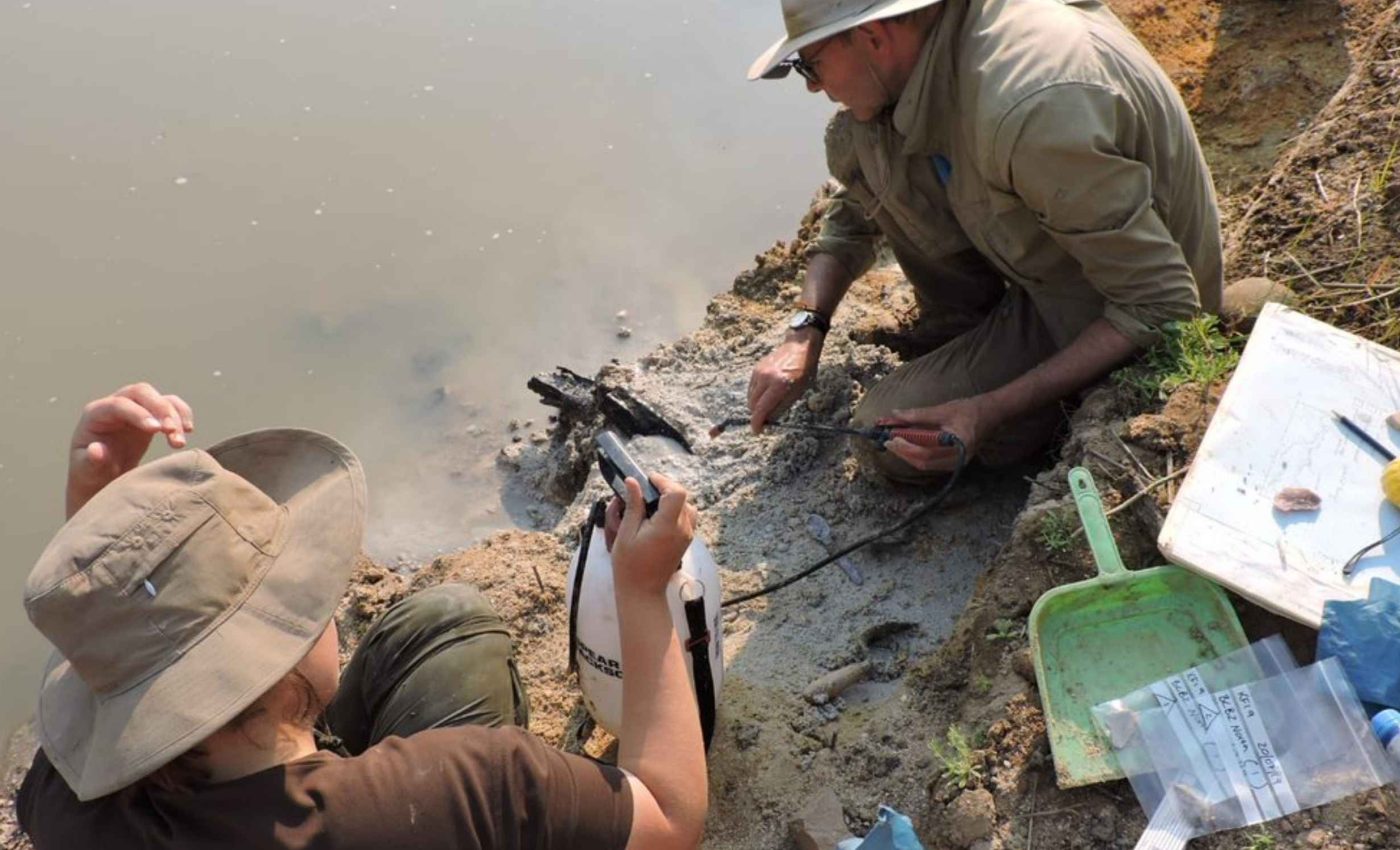
Archaeologists working at Kalambo Falls in northern Zambia have uncovered two large wooden logs that once formed part of a deliberately-built structure.
The discovery reveals that very ancient builders were already reshaping their environment with timber long before written history.

A recent study dates the preserved wood to about 476,000 years ago, hundreds of thousands of years before Homo sapiens appeared.
That timing shows that people were building with fitted-wooden logs instead of using wood only for tools or firewood.
Log structure at Kalambo Falls
The research was led by Larry Barham, an archaeologist at the University of Liverpool. His work focuses on how early technologies in Africa changed the daily lives of ancient communities.
Kalambo Falls sits on the border between Zambia and Tanzania, close to the southeast edge of Lake Tanganyika.
The waterfall drops 770 feet and the archaeological landscape appears on a UNESCO tentative-list for World Heritage status, according to a record.
Beneath the cliffs, banks of the Kalambo River hold deep layers of sand and mud that stay waterlogged throughout the year.
That constant dampness slowed decay, so wood and plant remains survived instead of crumbling away as they do at most ancient sites.
The discovery comes from the Deep-Roots of Humanity research project, which explores how technology changed in south central Africa.
That work focuses on the period between about 500,000 and 300,000 years ago, when new ways of making and combining tools emerged.
Reconstructing an ancient platform
At the heart of the find are two logs arranged so that one lies across the other with a notch cut where they meet.
The logs were almost certainly shaped by a hominin, an early human or close evolutionary relative, using sharp stone tools.
Microscopic study of the wood reveals straight cut marks, scraping scars, and smoothed facets that are hard to explain as water damage alone.
The way the notch edges were shaved and the surfaces leveled suggests deliberate carpentry rather than driftwood swept into place by the river.
Nearby, archaeologists also uncovered a pointed wedge, a digging stick, and other modified pieces of wood that together look like a small toolkit.
These tools would have helped to chop trees, split logs, and work the soil, turning raw forest resources into usable building material.
The way the logs lock together suggests a raised platform or working surface by the river rather than a random pile of lumber.
Dating the logs at Kalambo Falls
Working out the age of the structure was not simple, because common techniques like radiocarbon dating do not reach so far back in time.
Researchers instead turned to luminescence dating, a technique that measures how long minerals in sand stayed dark.
Grains of quartz and feldspar from the surrounding sediments were collected in opaque tubes so that no new light reset their internal clocks.
In the laboratory, scientists stimulated these grains, measured the faint light they emitted, and calculated how long they had been buried.
“At this great age, putting a date on finds is very challenging,” said Geoff Duller of Aberystwyth University. His team applied these methods to layers above and below the wood so that the dates formed a pattern rather than an isolated number.
The results fell into three time bands, with the interlocking logs in the oldest band and the other wooden tools in slightly younger layers.
Because the dates line up with the order of the sediments, it is unlikely that the structure slid in from a younger layer.
Life beside a powerful waterfall
Kalambo Falls would have offered early communities steady flowing water, fish, and rich plant life in the surrounding forest.
Such a setting could support repeated visits or long stays, giving people reasons to build features that made the riverbank more comfortable and secure.
Excavations over decades have revealed a sequence of stone tools at the site, stretching from the early Stone Age through the Iron Age.
That long record, combined with the wooden structure, shows that this riverside location anchored human activity again and again across a span of time.
A wooden platform would have kept people above wet ground, away from mud and insects, and given them a place to sit or work.
Putting that much effort into a built surface suggests that people were not simply passing through but were investing work in a familiar place.
The platform, taken with the long-sequence of tools, hints at a way of life that mixed movement with regular returns to key spots.
Lessons from Kalambo’s log structure
For most early periods, archaeologists mainly study stone, bone, and sometimes shell, because wood usually decays beyond recognition.
Finds like those at Kalambo open a window onto a hidden part of technology, showing how much has been missed because organic materials rarely survive.
Some researchers describe the stacked logs as the earliest known wooden structure. The find shows that communities using Acheulean, an early stone tool tradition with large cutting tools, used wood for more than spears.
Joining heavy logs in a stable cross shape takes planning, knowledge of how tree trunks behave, and probably cooperation among several workers.
Archaeologists also see links between the Kalambo structure and later hafting, the practice of fixing tool heads onto handles.
Taken together, the logs, tools, and dates suggest that long ago some communities were planning projects, reshaping their surroundings, and treating particular spots as bases.
“Forget the label ‘Stone Age,’ look at what these people were doing: they made something new, and large, from wood,” said Barham.
The study is published in Nature.
—–
Like what you read? Subscribe to our newsletter for engaging articles, exclusive content, and the latest updates.
Check us out on EarthSnap, a free app brought to you by Eric Ralls and Earth.com.
—–