Borrowed DNA helped warblers evolve vivid colors



 Follow Earth on Google
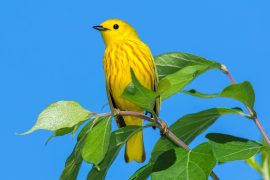
Wood warblers stop people in their tracks. They flash yellow, red, orange, blue, and even pink as they move through trees and shrubs across North America. There are more than a hundred species, and many look so different that it is hard to believe they are closely related at all.
For years, bird lovers and scientists alike have asked the same simple question: How did so much color arise in such a short slice of evolutionary time?

New research suggests the answer is not as straightforward as slow, isolated change. Instead, some warblers appear to have picked up color traits from their neighbors, even from species that are not closely related.
This genetic sharing offers a fresh way to think about how nature builds variety so quickly.
Genes that color warblers
The study was led by David Toews, a professor of biology at the Penn State Eberly College of Science.
His team focused on genes tied to carotenoid pigments, which create bright yellows, reds, and oranges in feathers. Food provides these pigments, but genes control how birds use and display them.
“Wood warblers are beloved by birders in part because of their wide variety of plumage colors, and it’s only natural to wonder how such diversity of colors arose in these beautiful songbirds,” said Toews.
It turns out that some of these birds may have borrowed colors from their neighbors rather than evolving them independently.
“We previously found evidence that a particular color-related gene had been shared between species within the same genus, which is one notch up on the taxonomic ladder, but now we show that there is gene movement from species in one genus to another,” explained Toews.
When species share DNA
The researchers analyzed DNA from about 400 warblers covering 100 species and six subspecies. They compared family trees built from whole genomes with trees built from individual color-related genes.
Because the trees did not match, the results hinted that genes had jumped from one species to another.
“When birds of two different species mate, their hybrid offspring inherit genes from both parents,” said study first author Kevin Bennett, a postdoctoral scholar in biology at Penn State.
“When that hybrid goes on to mate with an individual of one of its parent species, it can pass on genes from the other. Over several generations, the genetic material from one species can be incorporated into the other, which is called introgression.”
Earlier work revealed that multiple wood warbler species in the genus Setophaga shared a version of the gene BCO2. But the gene’s origin was puzzling, hinting that it came from outside the group.
The new analysis confirms that suspicion and demonstrates that BCO2 has repeatedly moved between species belonging to a different genus.
Turning yellow on and off
One gene in wood warblers stood out. Beta-carotene oxygenase 2, or BCO2, acts like a switch. When it is active, it breaks down yellow pigments, leading to paler feathers. When it is inactive, yellow pigments build up.
The team found signs that this gene moved between several warbler groups, including from the genus Leiothlypis into multiple species of Setophaga and Cardellina, and from Vermivora into Geothlypis.
“We think the initial introgression events from Leiothlypis occurred between half a million to two million years ago – while the donor and recipient species themselves diverged several million years before that,” Toews said.
Despite millions of years of evolution and speciation, the borrowed version of BCO2 has persisted. The researchers think the variant slightly alters the protein, affecting yellow plumage used in mate choice.
That influence on mating decisions may help explain why the gene keeps spreading. The team now plans to test the functional consequences of this genetic variant.
Color evolution still working in warblers
In one case, the process may still be happening. Not every red-faced warbler carried the shared version of BCO2, suggesting the gene has not yet spread through the entire species.
“We are sampling additional red-faced warblers from across a broader geographic range to try to catch this evolutionary process in the act,” said Bennett.
“We hope to get a better sense of where this version of the gene has come from, how far into its geographic range it has reached, and how it impacts the ecology of the birds.”
How warblers turn red
The team also examined two genes, BDH1L and CYP2J19, which work together to turn yellow pigments into red ones. Only five wood warbler species are red, making these genes especially interesting.
Evidence showed BDH1L moving from a red Cardellina species into two red Myioborus species, and CYP2J19 moving between two Myioborus species.
“Only five of the more than 100 species of wood warblers are red, and one of these recipient Myioborus species has populations that are red and some that are yellow,” said Bennett.
Evidence of introgression appeared exclusively in the red population. This provides strong support for a direct link between gene flow and the birds’ color differences.
“We think it is possible that wood warblers had a single evolutionary origin of red plumage and that it was passed on to the other red species through introgression from there.”
Rethinking how evolution works
Across all the genes studied, the researchers identified at least nine cases of introgression involving BCO2 and additional cases involving the red-related genes.
This scale of gene sharing is unusual for vertebrates and hints that it may be more common than once thought. Swapping useful genes may help species adapt faster than waiting for random mutations.
“Without modern tools, like high-throughput DNA sequencing, the intertwined history of these birds would remain hidden,” said Bennett.
“It’s really exciting to uncover the hidden stories of the birds and to see how genes from independent evolutionary lineages can come together to solve evolutionary problems.”
The full study was published in the journal PLOS Biology.
—–
Like what you read? Subscribe to our newsletter for engaging articles, exclusive content, and the latest updates.
Check us out on EarthSnap, a free app brought to you by Eric Ralls and Earth.com.
—–